Uber-like ride-hailing app developmentfor your own mobility brand.
Swaggy’s Uber-like ride-hailing app development connects passenger and driver apps, live dispatch, trip tracking, flexible ride models and payments around the way your market operates.
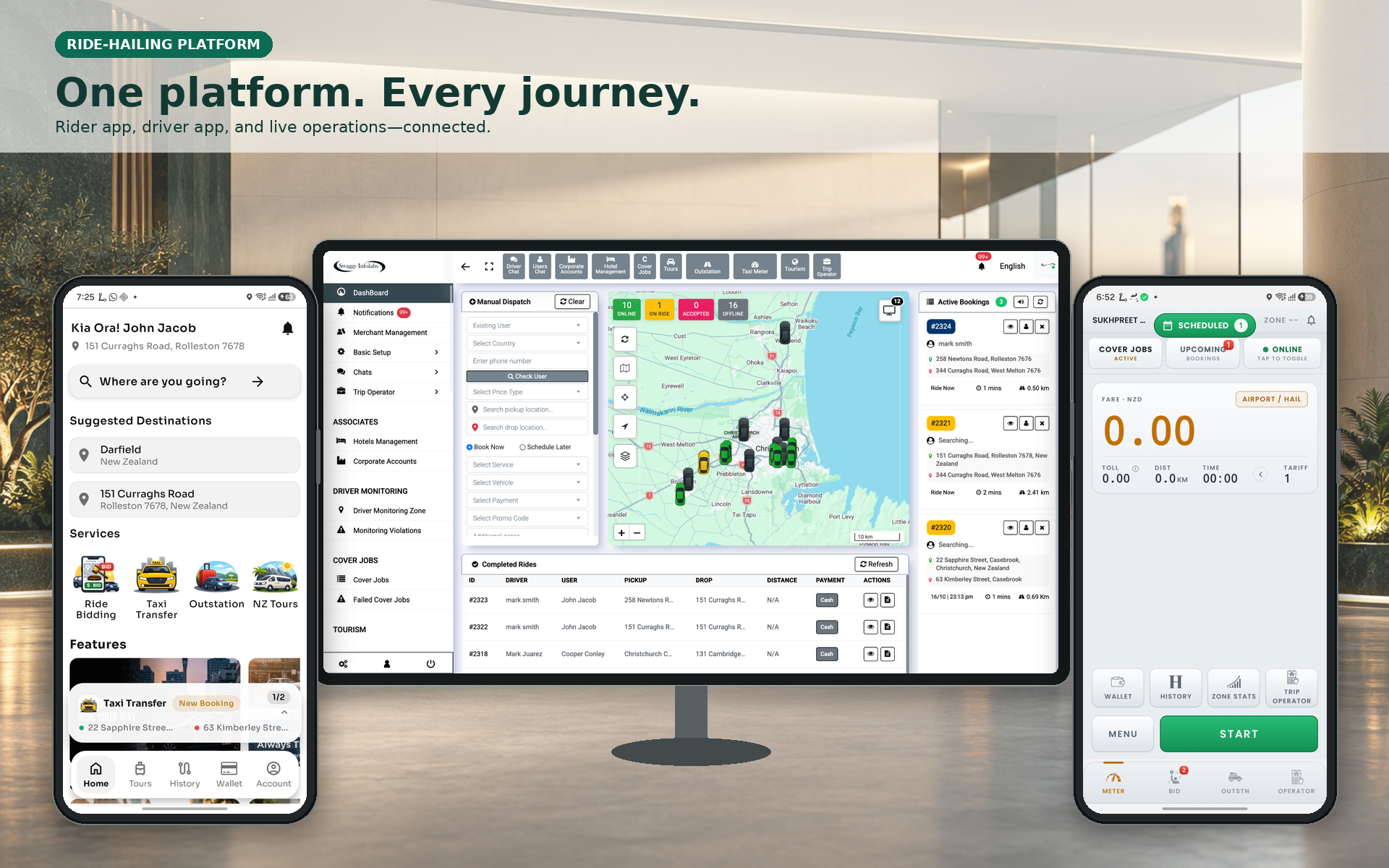
“Uber-like” describes a ride-hailing business model. Swaggy Info Labs is independent and is not affiliated with or endorsed by Uber Technologies, Inc.
Technology partners.
Powered by Swaggy.
Swaggy technology is developed for real transport operations. Experience with independent mobility brands informs how we connect booking, dispatch, driver job states, fare calculation and the controls needed to run more than one service as a business grows.
- BAJ
- Fast Ride
- Pleasure Drive
- Uma Cabs
- Taxi Club
- Yum
- Phemmy
- King Cabs
The result is a platform that can be demonstrated through real interfaces and real workflows rather than relying only on concept screens. Buyers can see how passenger booking, driver operations, dispatch, fare controls and platform management connect from end to end.
GST & tax customisation.
Configured for your country.
Ride-hailing platforms operate inside tax and marketplace rules that differ by country and by business model. Swaggy can be configured to record the commercial components needed for the client’s model — such as trip value, commission, platform fees, applicable taxes, driver/provider details, payment status and settlement data — so the system can support local accounting and reporting workflows.
GST, VAT and other marketplace taxes can depend on the operating country, the supplier of the service, payment collection and the relationship between the platform and its drivers or operators. Keep tax rates, fee logic, invoice fields and reporting configurable for the agreed jurisdiction.
Record the commercial components
Trip value, commission, platform fees, applicable taxes and payment status can be scoped for your operating model.
Keep the right details together
Plan driver or provider information, invoice fields, settlement data and accounting/reporting outputs for the agreed jurisdiction.
Customise the implementation
Country-specific rules are implemented or integrated within your project scope, with requirements confirmed by your team and advisers.
Swaggy can implement or integrate the required rules for the agreed jurisdiction and operating structure, while the client remains responsible for confirming the applicable legal, tax, licensing and payment requirements with its advisers and authorities.
Build a ride-hailing business.
Connect the operation behind the app.
An Uber-like app is easy to describe: a passenger requests a ride, a driver accepts it, the trip is tracked and the customer pays. The difficult part begins after launch. A real mobility business needs pricing rules, vehicle categories, service areas, driver eligibility, payment handling, cancellations, airport workflows, long-distance trips, support tools, settlement records, promotions, reporting and a control centre that keeps everything connected.
Swaggy Info Labs approaches ride-hailing as an operating platform rather than a screen-by-screen copy of another company. Your brand can use familiar booking patterns while configuring the workflows, ride types, fare models, driver rules and commercial controls needed for your own city, country and business model.
That makes the platform suitable for a startup launching a new ride-hailing brand, an established taxi company modernising its fleet, a transport network connecting independent drivers, or a travel business that wants mobility and tourism services in one digital ecosystem.
Request
Capture pickup, destination, service selection and the appropriate fare flow.
Match
Connect an eligible driver through the configured dispatch or bidding workflow.
Travel
Keep driver activity, trip progress, location and fare tools connected.
Complete
Finish the trip with payment status, receipts and the required commercial records.
Make booking simple.
Keep your business flexible.
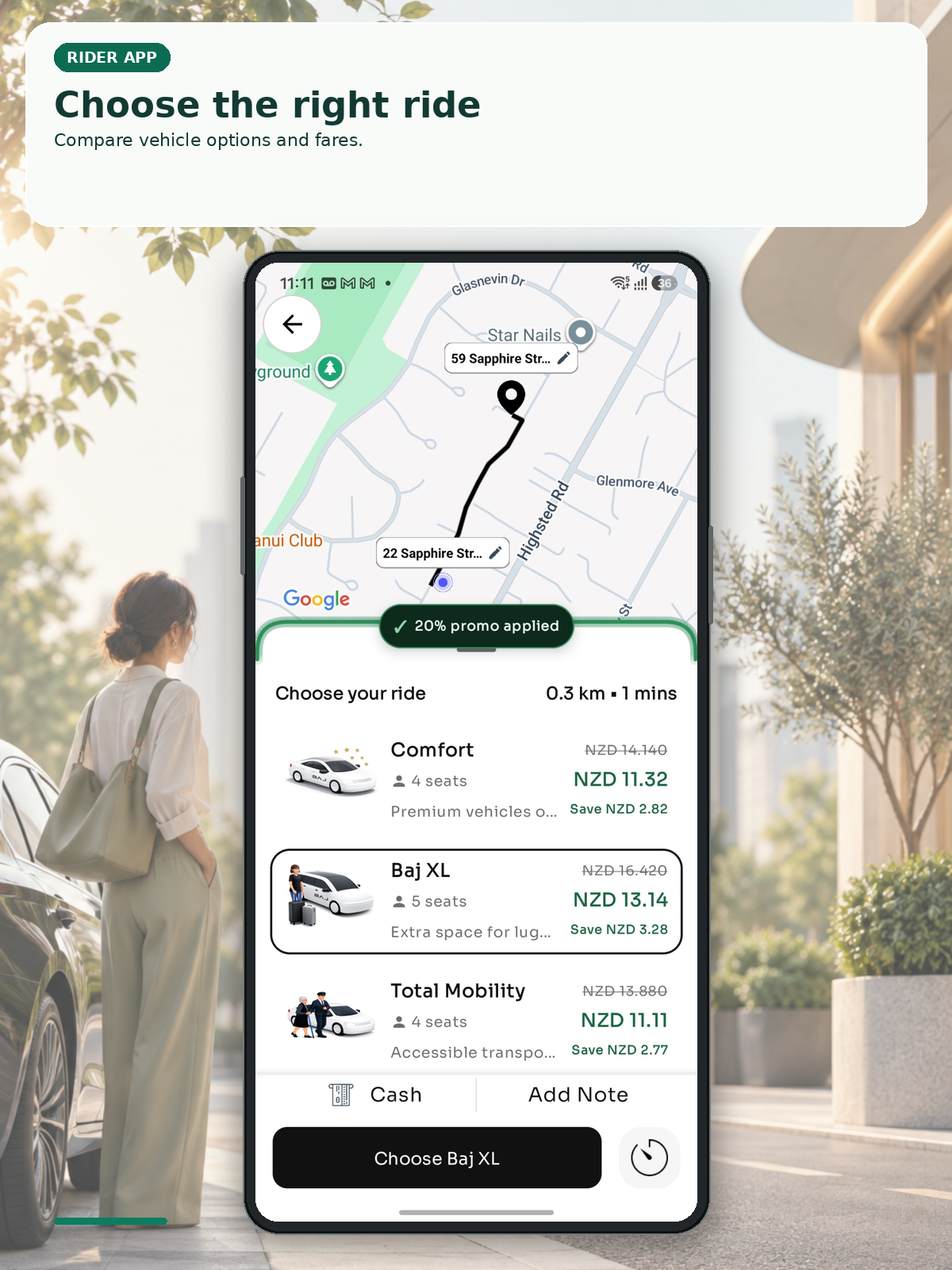
The passenger app is where your brand meets the customer. Swaggy can support a clean booking journey for immediate rides and advance services while allowing different ride models to sit inside the same app. The experience can be branded around your company rather than forcing customers into a generic template identity.
- Mobile registration and secure account access
- Pickup and destination selection with map/location support
- Ride Now and scheduled booking workflows where enabled
- Vehicle and service category selection
- Fare estimate or service-specific pricing display
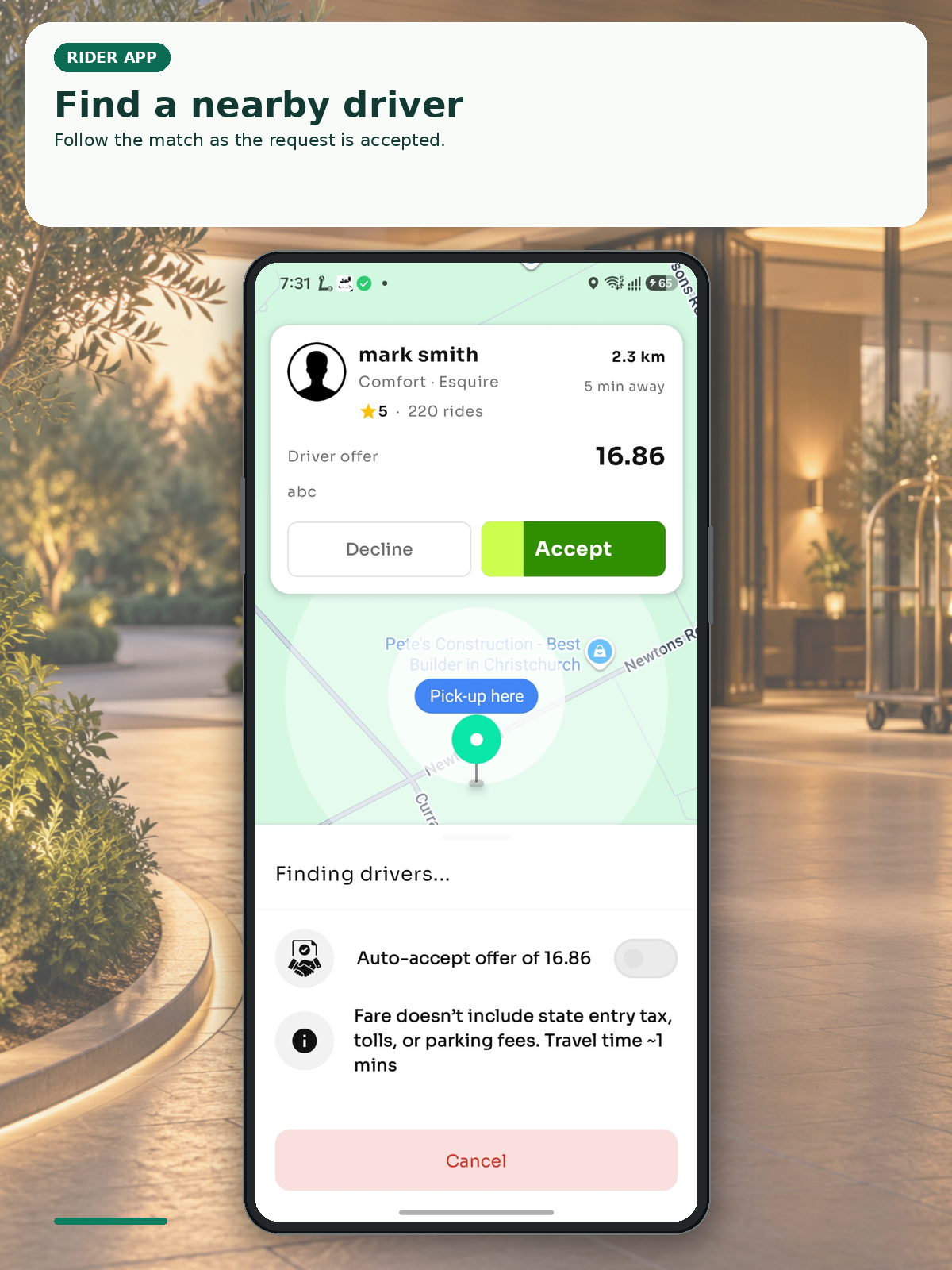
- Ride bidding for eligible instant-ride services
- Ride share/pooling workflows when part of the operating model
- Outstation and intercity booking for long-distance travel
- Airport transfer booking and pickup instructions
- Cash, card, wallet or other configured payment methods
- Promo code, referral and campaign support
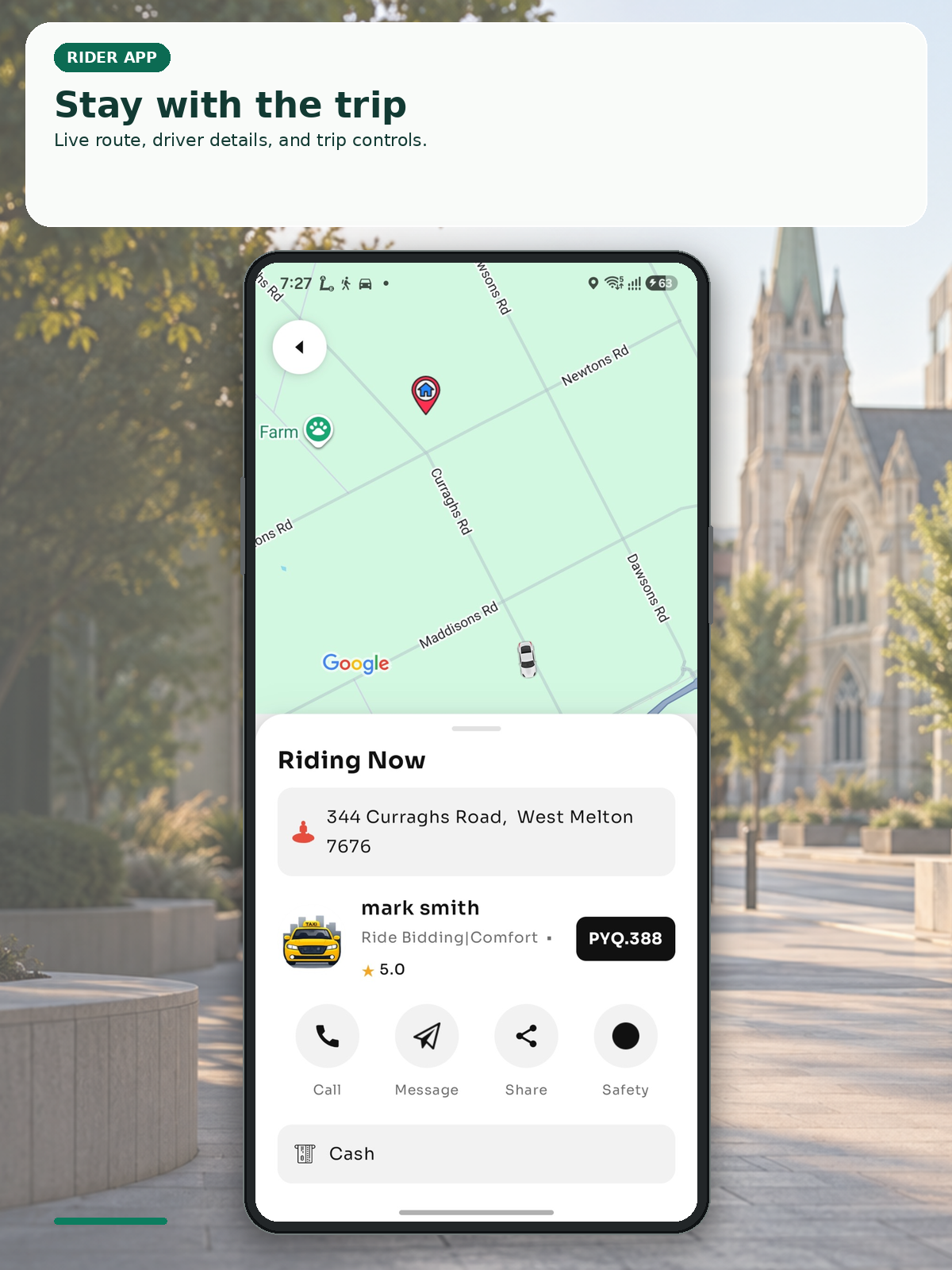
- Live booking status, driver details and trip tracking
- Trip history, receipts, ratings and support-related records
From going online
to completing the work.
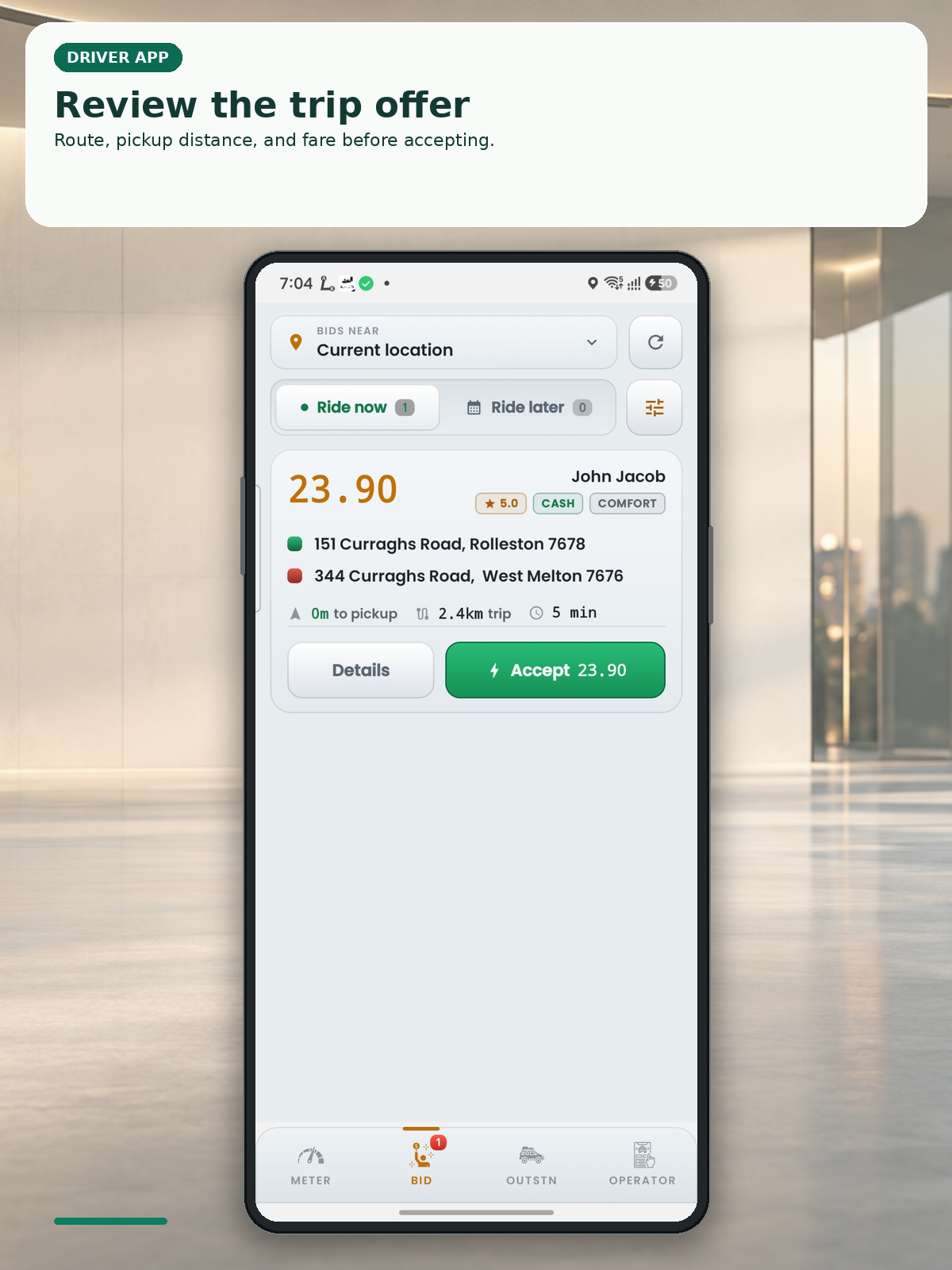
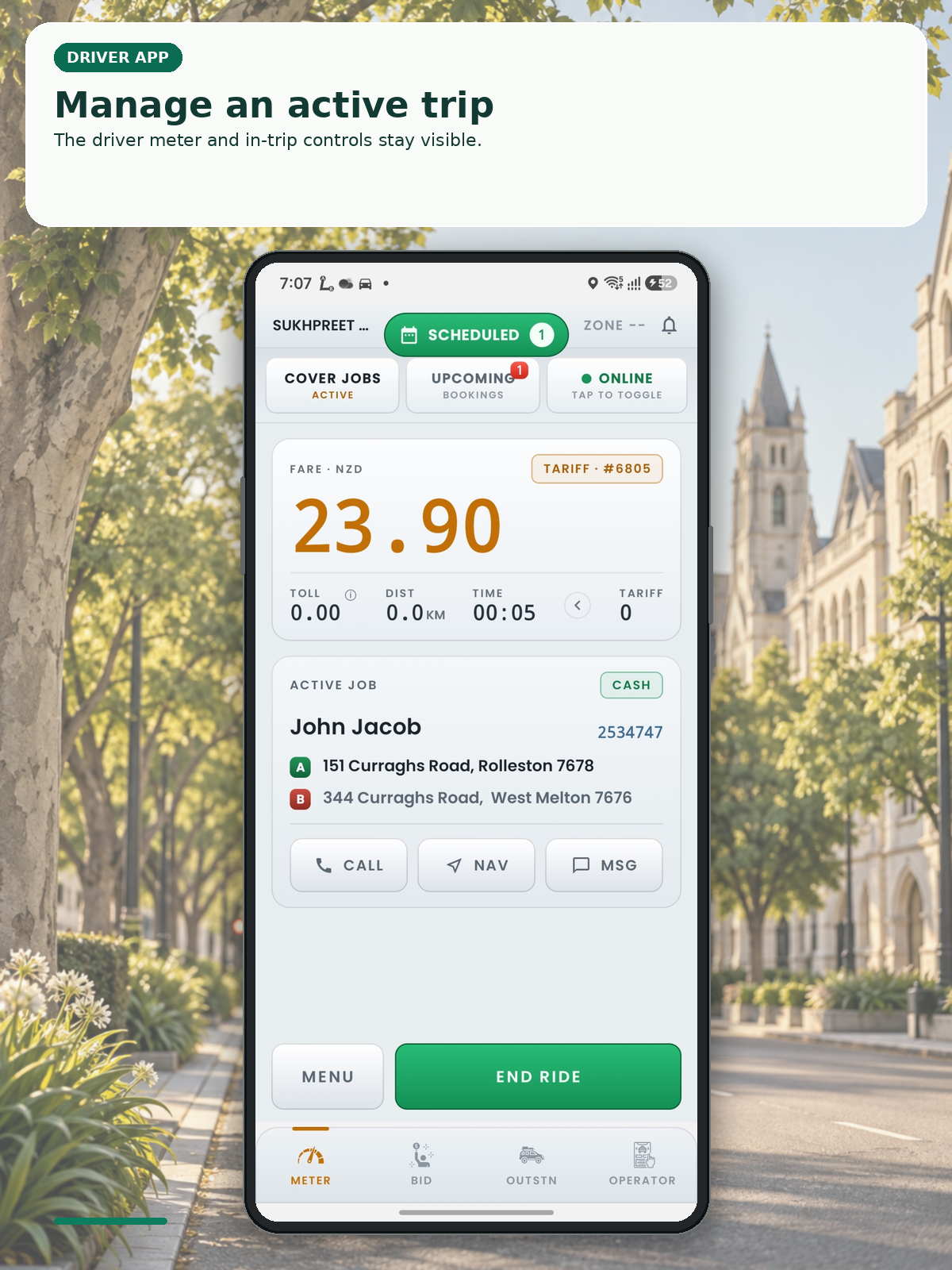
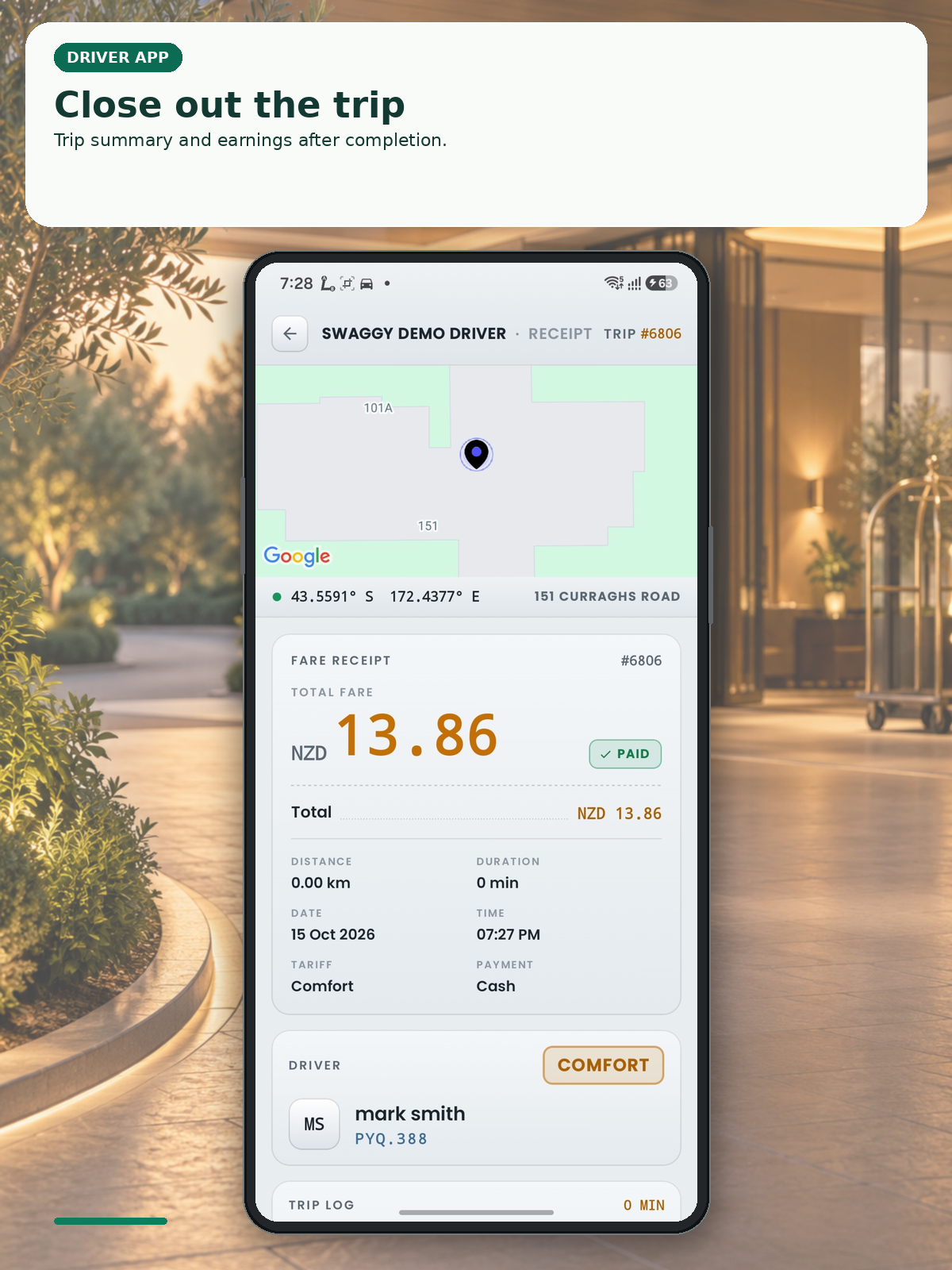
The driver app needs to do more than display a job card. It connects the driver to dispatch, route information, trip status, fare tools, earnings information and the operator’s rules. Swaggy can configure driver access around approved service categories, vehicles, documents and the type of work the driver is eligible to receive.
- Online/offline availability and driver-status workflow
- Real-time eligible job offers and booking information
- Accept, reject or respond according to the configured ride model
- Pickup navigation and passenger/trip information
- Arrival, trip-start, in-trip and completion status controls
- Live location during active operation where enabled
- GPS-based fare/meter tools for taxi services that require them
- Automatic toll or configured trip-charge support where available
- Driver earnings, commission or wallet information where configured
- Vehicle and driver document management workflows
- Operational, booking and promotional notifications
- Approved operator-network tools for redistributing or managing bookings
A connected control centre.
For the business behind every ride.
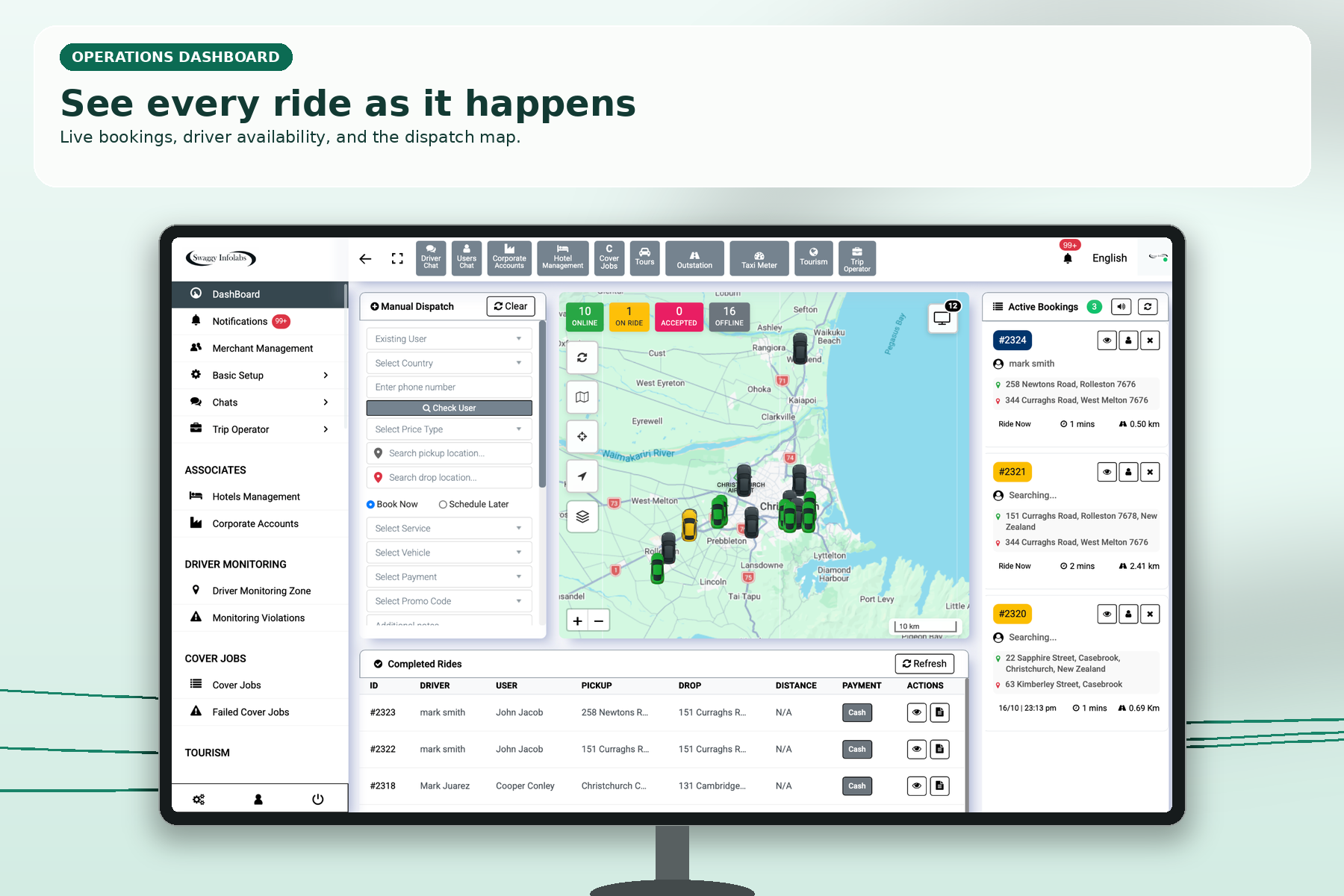
Passenger and driver apps create the experience, but the dispatch and administration layer controls the business. Swaggy gives the operator a central system for bookings, drivers, vehicles, fares, service types, availability, reporting and operational rules. This is where a ride-hailing application becomes a manageable transport network.
The platform can combine automated job distribution with manual dispatch. Automatic matching is useful for high-volume everyday rides; manual control remains valuable for airport work, corporate bookings, accessibility vehicles, groups, special requests and exception handling.
- Live bookings, booking status and trip history
- Driver and vehicle availability on the operational map
- Automatic and manual allocation options
- Driver, vehicle, category and service management
- Fare rules, zones, minimums and service-specific configuration
- Platform commission, wallet and payment-related controls where enabled
- Promo, referral and notification management
- Reports for bookings, trips, driver activity and commercial records
- Multi-service and multi-city controls for expansion
More than one way to ride.
One brand to bring it together.
A modern mobility company may need several products under one brand. Swaggy can separate ride types and rules so customers choose the service that fits their journey while drivers receive only the work they are eligible to perform.
| Ride model | How it can work |
|---|---|
| On-Demand Ride-Hailing | Immediate point-to-point requests with driver matching, live status and configured fare rules. |
| Scheduled Taxi / Private Hire | Advance bookings with service-specific confirmation and dispatch workflows. |
| Ride Bidding | Passenger proposes a fare for an eligible instant request; drivers can accept or counter according to the configured model. |
| Ride Share / Pool | Shared-ride functionality for compatible journeys where the operator chooses to offer pooled transport. |
| Outstation / Intercity | Long-distance bookings between cities, regions or service areas with separate pricing and operational logic. |
| Airport Transfers | Airport-focused booking with pickup instructions, flight-related information and dedicated operational rules where configured. |
| Corporate / Account Travel | Business booking and reporting workflows for authorised organisations or account customers. |
| Tourism Ground Transport | Private transfer, destination transport and tour-related mobility that can connect with a wider travel marketplace. |
Service availability, pricing and operating rules are agreed for your deployment.
Ride bidding.
Let your marketplace respond.
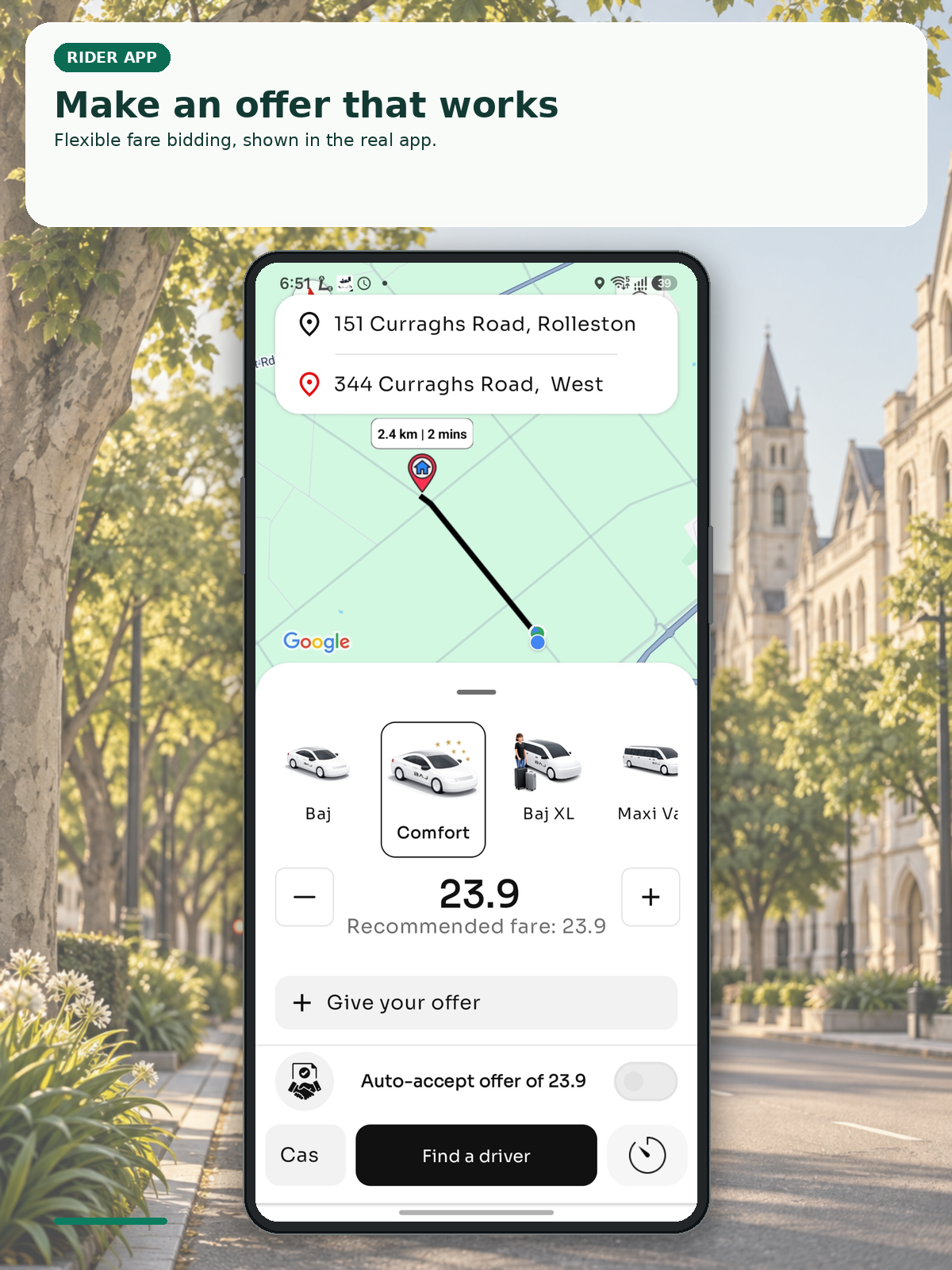
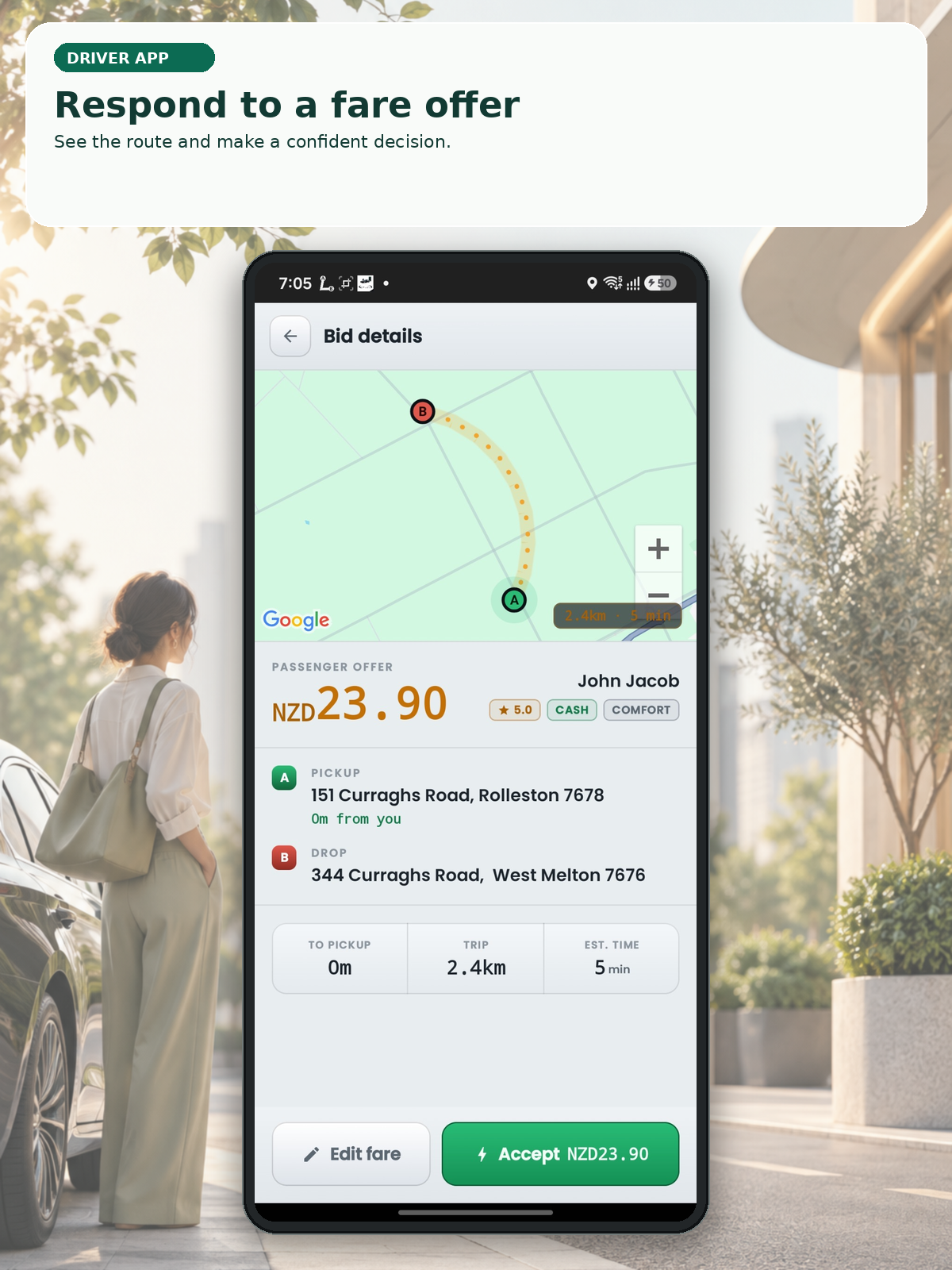
In some markets, a fixed algorithmic fare is not the only way customers and drivers want to transact. Swaggy can support a ride-bidding model in which a passenger suggests a fare for an eligible immediate ride and drivers can accept the request or make a counter-offer. The customer can then choose based on the available response.
The feature can operate alongside normal taxi or ride-hailing services rather than replacing them. This gives the platform owner the flexibility to decide which services use estimated pricing, meter-based pricing, fixed fares or negotiated bidding.
Shared demand. Longer journeys.
Rules built around the service.
Ride share and pooling
Where the business model supports shared transport, the platform can be extended to match compatible ride demand and manage pooled journeys. The important distinction is that shared rides should not be treated as a decorative toggle: vehicle capacity, pickup sequencing, pricing, timing and passenger communication need to be configured around the intended operating model.
Swaggy can treat ride sharing as one service within a wider mobility platform, allowing the same brand to offer private rides, taxis, intercity bookings and shared options without maintaining completely separate systems.
Outstation and intercity travel
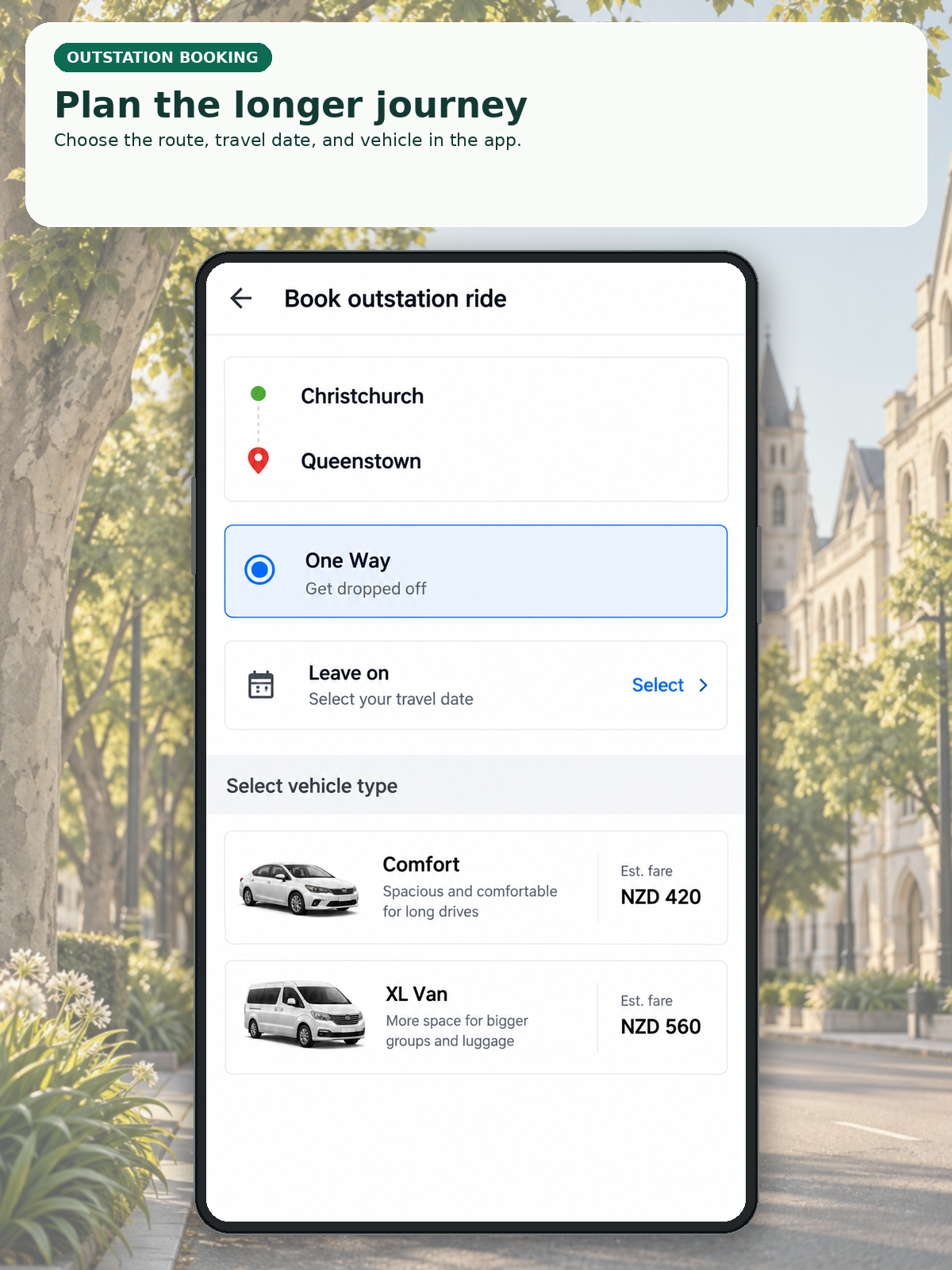
Many ride-hailing products are designed mainly for short urban journeys. Swaggy can support outstation and intercity travel as a separate service with longer-distance booking logic, advance planning, suitable vehicle categories and market-specific pricing. This is particularly valuable in countries where city-to-city taxis and private cars are a major part of the transport market.
The service can be configured for one-way, return or customised journey types depending on the operator’s commercial model. It can also connect naturally with tourism transport, airport transfers and destination travel.
Connect approved operators.
Redistribute suitable work.
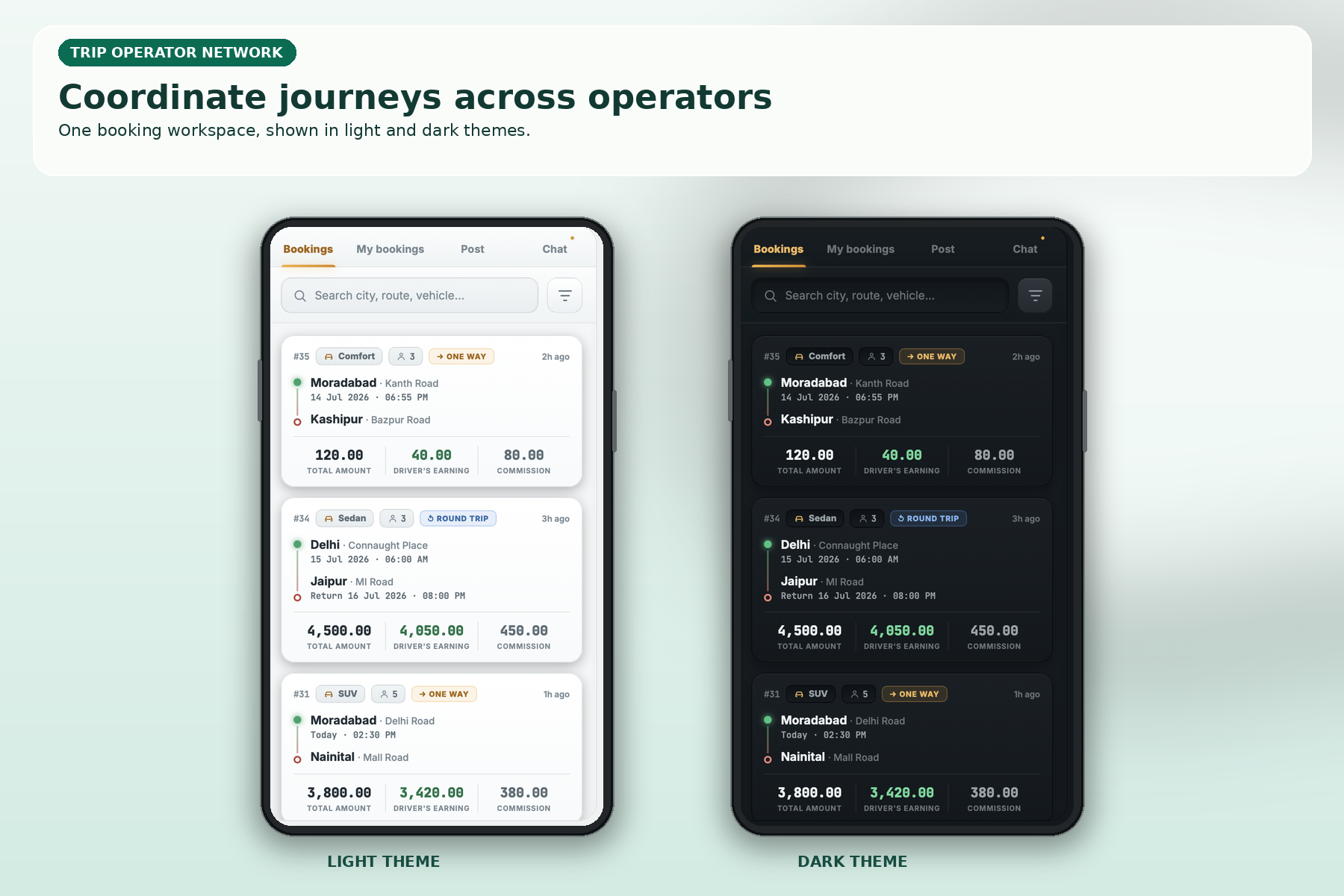
One of the strongest differences between a simple ride-hailing clone and a broader transport marketplace is what happens when the original driver or operator cannot perform the booking. Swaggy can support an approved Trip Operator Network where eligible participants can manage, publish or redistribute suitable bookings to other drivers or transport operators according to platform rules.
This can help a network recover overflow jobs, cover work outside a normal pickup area, find a suitable vehicle for a group or accessibility requirement, and turn independent drivers into more capable transport operators. The platform owner retains the operational framework while participants gain a controlled way to collaborate.
- 01
Identify suitable work
Review overflow, out-of-area or specialist vehicle requirements.
- 02
Share under your rules
Make eligible bookings available to approved participants.
- 03
Keep operations connected
Manage allocation and booking visibility within the platform’s agreed framework.
Capture bookings
beyond the consumer app.
Not every customer wants to download an app. Hotels, serviced apartments, hospitals, restaurants, tourism desks and reception teams often need to arrange transport on behalf of a guest. Swaggy can provide a hotel/reception booking panel or kiosk-style tablet experience connected to the same dispatch ecosystem.
This creates another demand channel for the operator without maintaining a separate booking database. A reception user can request transport, while the booking follows the same driver, dispatch and trip-status workflow as other jobs.
Discuss your booking channels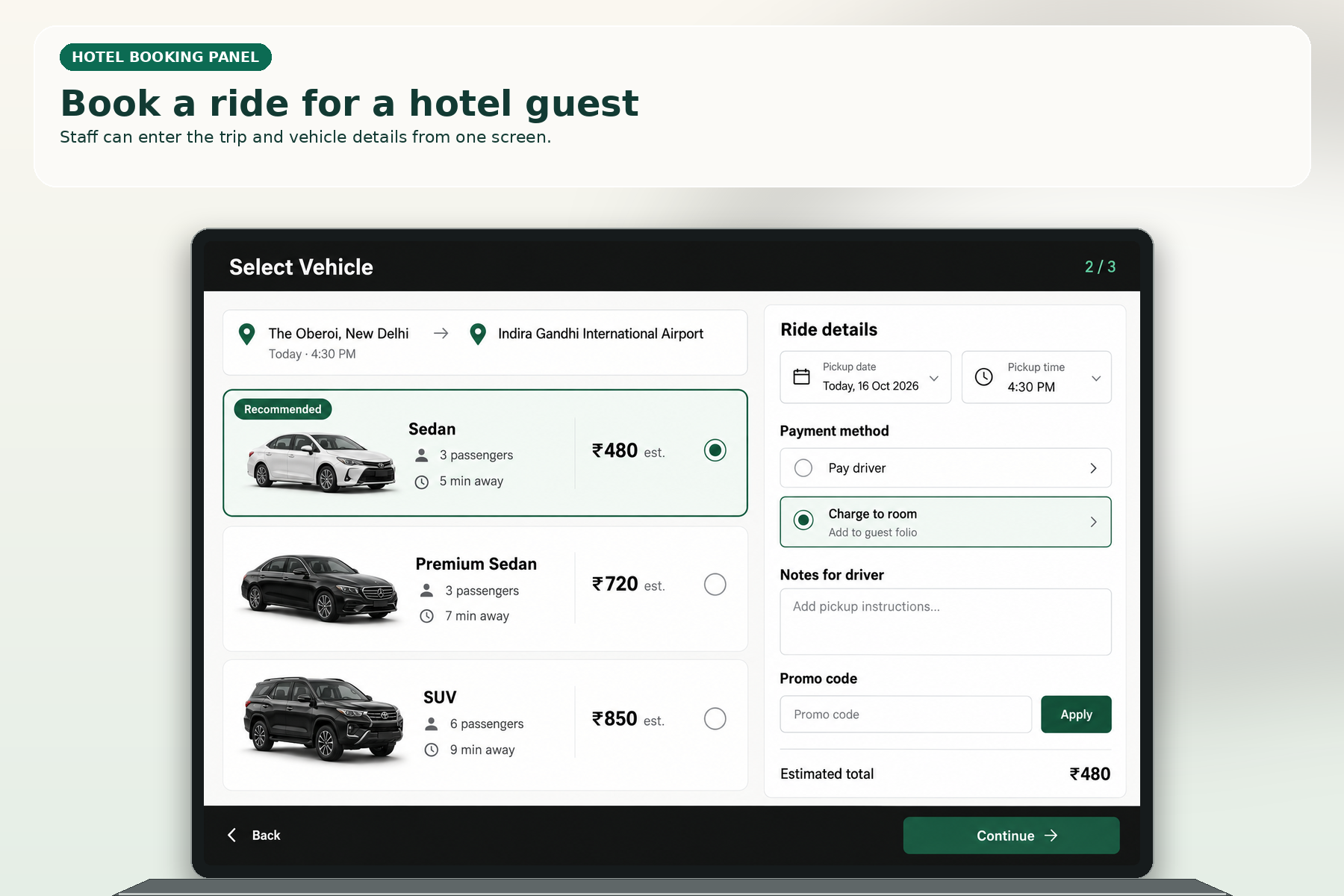
The right service.
In the right operating area.
Zones and geofencing
A ride-hailing platform should understand where a service is allowed, where particular rules apply and which drivers should receive work. Swaggy can use configurable service areas, zones and geofencing logic to support operational controls around airports, cities, regions, designated pickup areas or other business-defined locations.
Zone events can also support operational monitoring and notifications when a business needs visibility around important areas. The exact use should be configured according to the operator’s legitimate operational, privacy and regulatory requirements.
Airport workflows and flight information
Airports have different pickup instructions, waiting rules, access requirements and timing challenges from normal street rides. Swaggy can support airport-specific information and booking workflows so drivers and operations teams can see relevant airport details and manage transfer work more consistently.
Where flight-data integrations are included, airport information can be surfaced within the operational workflow to help teams manage arrival-based transport. This is especially useful for hotel transfers, private hire, tourism transport and pre-arranged airport bookings.
Match the fare model
to the journey you sell.
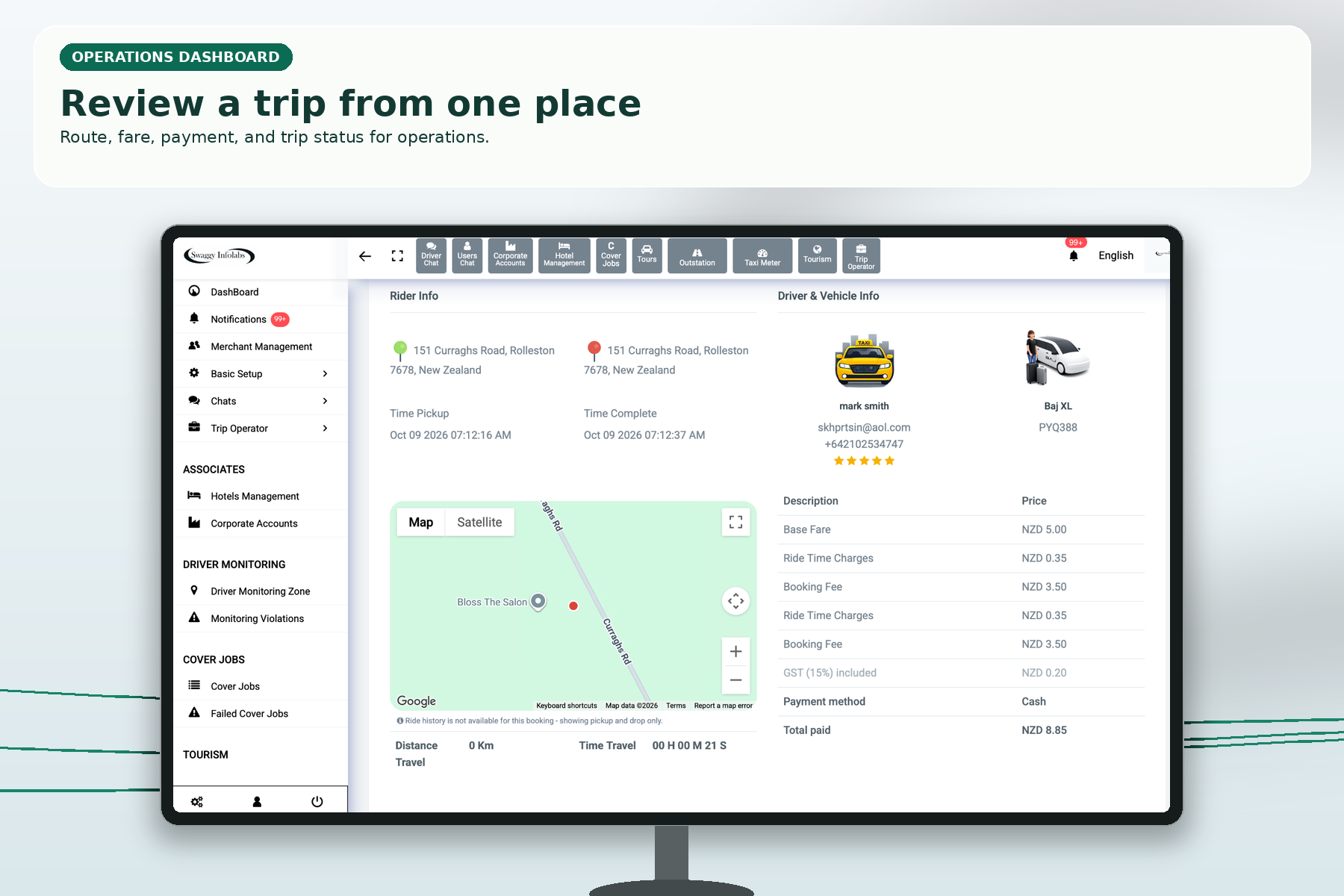
Different mobility services need different ways to calculate what the customer pays. A taxi may use GPS-based meter logic. A ride-hailing category may use an estimated or configured fare. An airport transfer may use a fixed amount. An outstation journey may use a separate distance/time structure. A bidding service allows customer and driver price interaction.
Swaggy can centralise these rules while keeping them service-specific. Operators can configure elements such as base charges, minimum fares, distance/time parameters, zones, toll handling, discounts, commissions and permitted customer-facing fees according to the product configuration.
Where legally permitted and supported by the chosen payment provider, the commercial setup can also separate an underlying trip amount from a booking, convenience or processing-fee component. This helps the operator model payment-gateway costs transparently instead of absorbing every transaction cost into the driver’s trip value.
Customer-facing booking, convenience or processing fees must be permitted by local requirements and the chosen payment provider, with the required disclosure.
Payments. Wallets. Settlement.
Connected to your operating model.
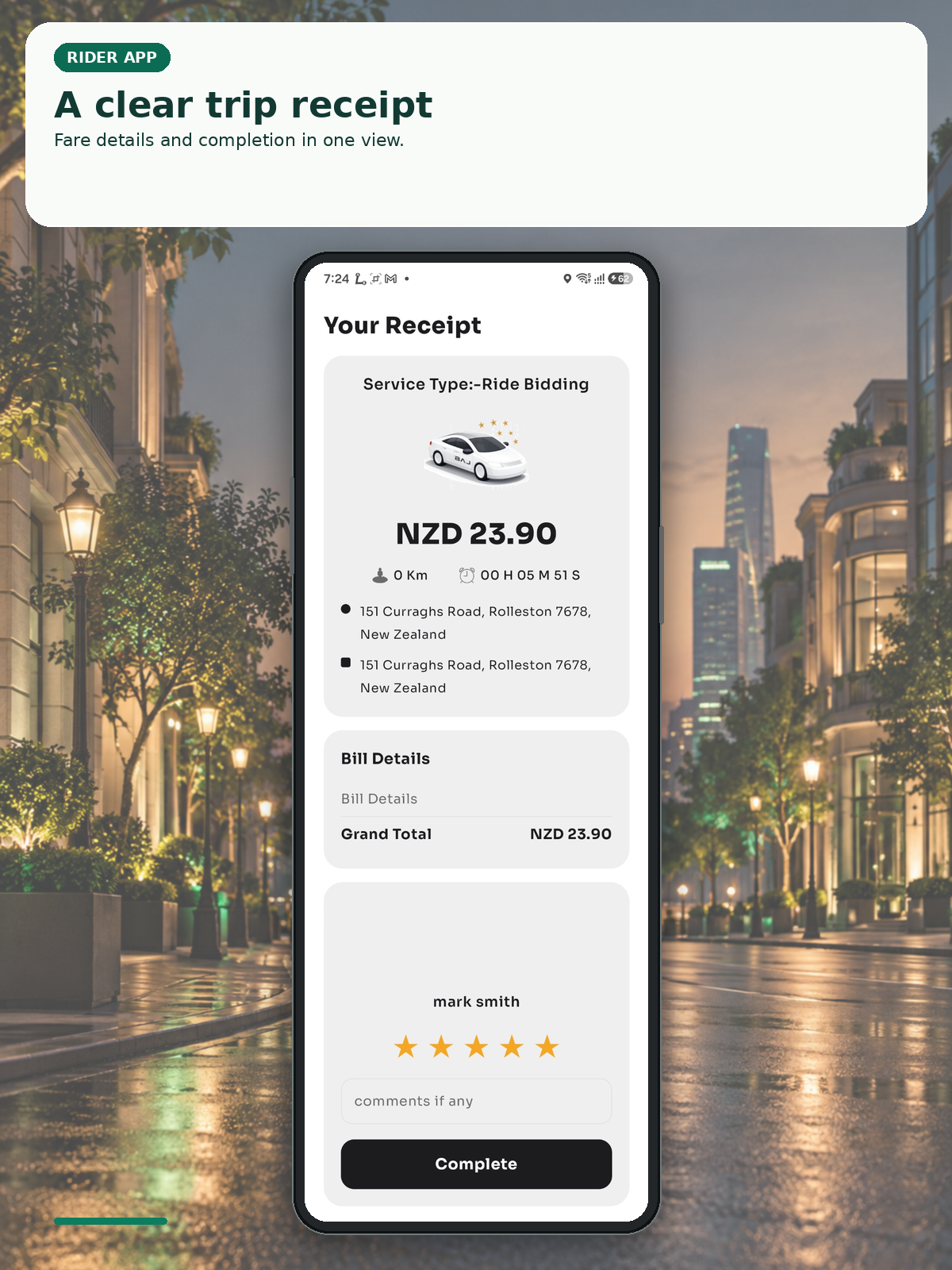
A complete ride-hailing business needs more than a payment button. Swaggy can connect the booking workflow with supported payment gateways, platform charges, driver or operator balances and settlement records according to the client’s chosen commercial model.
- Card or digital payment integration through supported providers
- Cash or direct-to-driver payment workflows where the business model allows them
- Customer wallet functionality where enabled
- Driver/operator prepaid wallet or platform-balance models where enabled
- Commission and platform-fee calculation
- Convenience or processing-fee configuration where legally permitted
- Driver/operator earning and settlement records
- Refund, cancellation and adjustment workflows according to the configured rules
Payment architecture can be adapted to the gateway and country rather than assuming that every market settles money in the same way. This becomes increasingly important when a ride-hailing brand expands across regions with different payment methods, tax rules and marketplace requirements.
Define who is eligible
for the work you offer.
A serious mobility platform needs a way to control who is permitted to receive work. Swaggy can support driver and vehicle onboarding workflows with configurable document types, review status and expiry information so the operator can apply its own eligibility rules.
- Driver identity and licence information
- Passenger-transport permits, endorsements or operator licences where applicable
- Vehicle registration and roadworthiness/compliance documents
- Commercial or required insurance records
- Expiry-date tracking and renewal reminders where configured
- Administrative approval before a driver or vehicle becomes eligible for work
- Service-category eligibility based on vehicle or operator requirements
The exact documents and enforcement process should be configured for the country and service. The software supports the workflow; it does not replace the transport authority or the operator’s legal compliance responsibilities.
Support the taxi workflow.
Plan for imperfect connectivity.
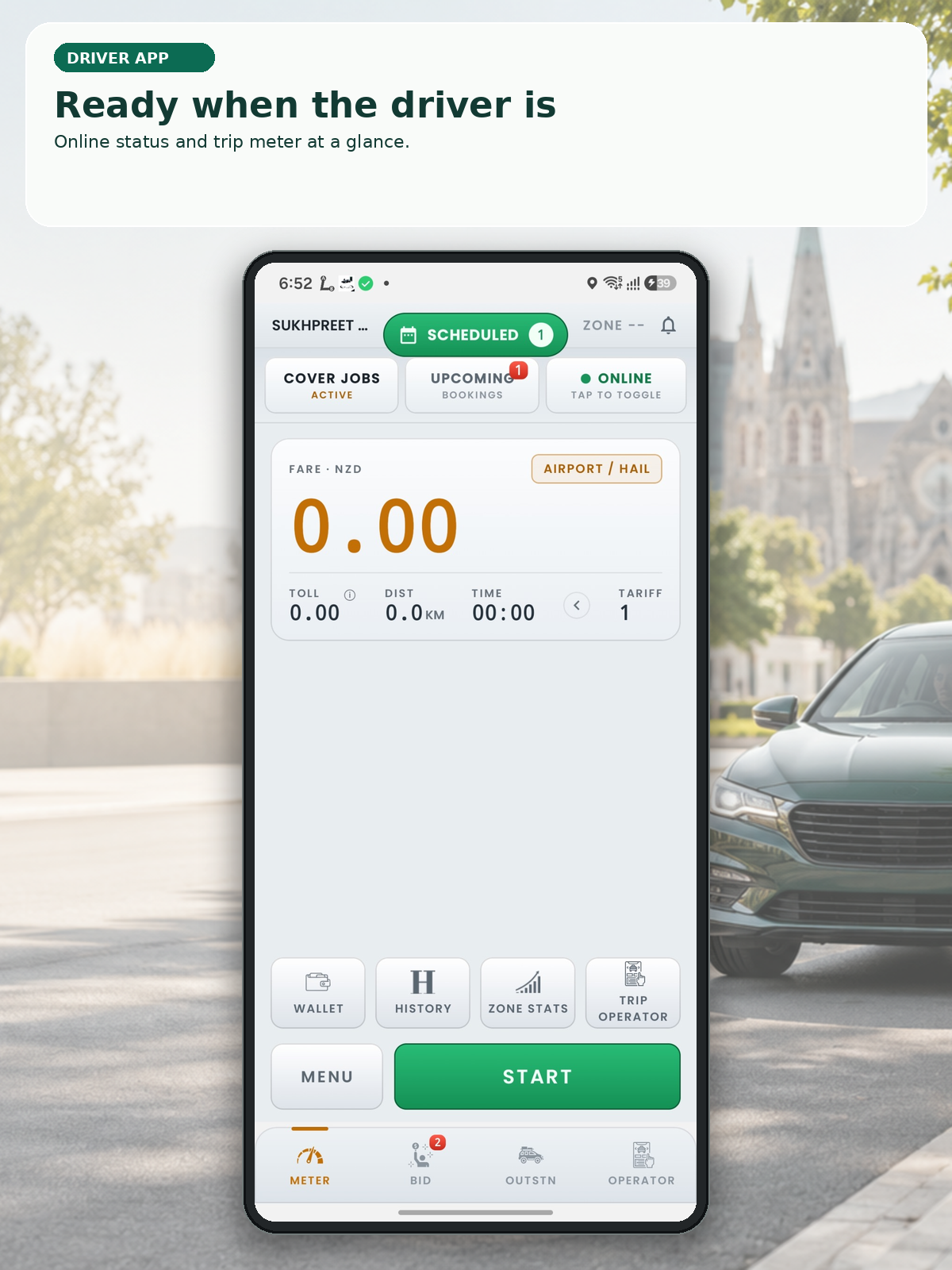
Traditional taxi operations may need a meter-style fare process even while the wider business moves to app-based dispatch. Swaggy’s GPS taxi meter technology can be integrated with the driver workflow to calculate configured taxi fares using location data and continue recording the trip through periods of weak connectivity, with data synchronised when connectivity returns.
This creates a practical bridge between conventional taxi operation and modern cloud dispatch. It is particularly valuable for fleets that cannot assume perfect mobile data coverage on every journey.
Calculate configured taxi fares
Connect GPS fare tools to the driver’s working trip.
Retain supported local records
Plan the supported meter behaviour during weak or unavailable connectivity.
Synchronise after reconnection
Bring recorded information back into the connected operating workflow.
Offline resilience applies to supported local fare/recording functions. Live dispatch, remote tracking and online payments still require connectivity.
Grow the service footprint.
Keep the operating picture connected.
A mobility platform that works in one city should not need to be rebuilt when the business adds another region. Swaggy can structure service areas, vehicle categories, ride types, fares and operational rules so a client can expand from one market to multiple cities or services while keeping central administration.
International expansion requires more than translating labels. Currency, tax treatment, payment gateways, driver requirements, cancellation rules, fee presentation and local transport regulation may all change. Swaggy can configure these layers project-by-project rather than presenting a single rigid global setup.
Your branded experiences
Passenger apps, driver tools and web booking channels.
Your service configuration
Service areas, ride models, vehicle categories, fares and administration.
Your surrounding systems
Mapping, notifications, payments and agreed third-party APIs.
Technology designed for continued development
Swaggy’s mobility systems are built around modern mobile and web technologies with API-based communication between customer apps, driver tools, backend services and integrations. The exact deployment stack can be aligned to the project, including native mobile development, scalable backend services, mapping/location services, notifications, payment gateways and third-party APIs.
For buyers, the important outcome is maintainability: the platform should be capable of adding integrations, new ride models, new payment options and market-specific rules as the business changes, instead of becoming a fixed one-off app that is expensive to evolve.
Build beyond local rides.
Connect the next part of the journey.
A mobility brand does not have to stop at local rides. Swaggy can connect transport technology with a broader tours and activities marketplace so customers can discover experiences, book destination transport and access local operators within one digital ecosystem. This is the model demonstrated through BAJ, where mobility services and tourism products can sit under the same broader travel platform.
For travel businesses, this opens a different growth path from a standard Uber-like application. The same customer relationship can extend from airport pickup to intercity transport, private tours, day trips and bookable experiences, while suppliers and transport operators use dedicated operational tools behind the marketplace.
A broader travel ecosystem
BAJ connects mobility with tours, activities and ground transport in a broader travel ecosystem. Explore the public marketplace, then ask the team to demonstrate the supplier and operational workflows relevant to your project.
Optional delivery expansion
Some mobility businesses want to use their driver network for more than passenger transport. Swaggy also develops on-demand delivery and multi-vendor technology, allowing a client to plan a wider local-services ecosystem without sourcing an unrelated technology vendor for every new vertical.
Delivery and multi-vendor requirements can be planned as a separate phase or connected service, with their own supplier, booking, payment and operational scope.
Starting a brand?
Modernising an existing business?
Ride-Hailing Startups
Launch a new branded mobility marketplace with the core rider, driver and operations stack already defined.
Taxi & Private-Hire Companies
Modernise phone/radio operations with apps, online booking, dispatch, GPS fare tools and digital administration.
Driver & Operator Networks
Connect independent drivers or transport businesses while keeping central platform rules and booking visibility.
Airport & Transfer Businesses
Combine scheduled booking, vehicle selection, flight/airport workflows and dispatch.
Travel & Tourism Companies
Add local transport, airport transfers, intercity travel and tours/activities to a broader marketplace.
Multi-City Mobility Brands
Run different zones, services, categories and operating rules across multiple markets from one technology ecosystem.
Look beyond familiar screens.
Evaluate the operating depth.
Evaluate the operating depth behind the rider and driver apps. Swaggy combines familiar ride-hailing with tools for taxi operations, operator marketplaces, intercity journeys, hospitality booking and tourism workflows, according to your project scope.
- Real product ecosystem developed for live mobility operations
- Taxi dispatch and app-based ride-hailing in the same technology family
- Ride bidding as an additional pricing/marketplace model
- Ride share/pooling support when required
- Outstation and intercity travel workflows
- Trip Operator Network for approved B2B booking redistribution
- Hotel/reception booking kiosk or tablet channel
- GPS taxi meter integration with offline resilience
- Zone/geofence and airport-oriented operational controls
- Configurable payments, wallet, commission and fee architecture
Country-specific tax and reporting configuration scoped to your market.
- Ability to connect ride-hailing with a tours and activities marketplace
Define the business.
Then build the launch plan.
- 01
Business & Market Discovery
Define the target city/country, service types, driver model, vehicle categories, booking channels, fare structure, payment flow and regulatory requirements.
- 02
Platform Scope
Select the modules required for launch: passenger app, driver app, admin/dispatch, website booking, hotel/kiosk, bidding, intercity, wallets, integrations and other operating tools.
- 03
Branding & Configuration
Apply the client brand and configure service areas, categories, fares, commission, fees, notifications, payment gateways and approved workflows.
- 04
Integrations & Market Rules
Connect maps, communications, payments and other agreed APIs; implement country/market-specific commercial and compliance configuration.
- 05
Testing & Operational Validation
Test the full booking lifecycle from customer request through driver allocation, active trip, fare/payment and administrative records.
- 06
Deployment & Continued Development
Deploy the agreed applications and backend, then add enhancements and new markets according to the commercial support/development arrangement.
Follow an actual journey.
Then inspect the controls behind it.
- Create a passenger booking from pickup to destination
- Show the driver receiving and progressing the booking
- Show the dispatch/admin record updating through each trip stage
- Demonstrate a ride-bidding request and driver response
- Open the outstation/intercity booking flow
- Show the hotel/reception kiosk booking channel
- Show a zone/geofence or airport-information workflow
- Demonstrate fare, toll, fee or wallet controls that are production-ready
- Show the Trip Operator Network workflow
- Finish with the BAJ tourism marketplace to demonstrate how mobility can expand into OTA-style travel technology
Ask to see the modules that are production-ready and included in your proposed deployment. Additional requirements are confirmed during scoping.
I am raw html block.
Click edit button to change this html
Your brand. Your ride models.
Questions before you launch.
Understand the workflows, market configuration and project scope behind your ride-hailing platform.
Ask about your projectWhat is an Uber-like ride-hailing app?
It is a branded digital platform that connects passengers with drivers through mobile apps and a backend operating system. A complete solution normally includes passenger booking, driver job management, dispatch, live tracking, fares, payments and administration. Swaggy can extend that core with bidding, outstation travel, hotel/kiosk booking, operator-network workflows and other modules.
Is Swaggy selling a copy of Uber?
No. “Uber-like” is used to describe the familiar ride-hailing business category. Swaggy develops and configures its own mobility technology for the client’s brand and operating model. The platform should use the client’s branding, workflows and market rules rather than copied Uber assets or interface designs.
Can we launch both taxis and ride-hailing in the same app?
Yes, the platform can be structured with different service categories and fare/dispatch logic so a business can offer app-based ride-hailing alongside taxi, scheduled, airport or other transport services.
Can passengers propose their own fare?
Yes, ride bidding can be enabled for eligible services. A passenger can suggest a fare and eligible drivers can accept or counter according to the configured rules.
Does the platform support intercity or outstation travel?
Yes. Long-distance travel can operate as its own service with different booking and pricing rules from normal urban rides.
Can hotels or reception desks book rides without the customer app?
Yes. A hotel/reception booking panel or kiosk-style tablet interface can feed bookings into the same dispatch ecosystem.
Payments, markets and growth.
The next questions to ask.
Understand the workflows, market configuration and project scope behind your ride-hailing platform.
Ask about your projectCan drivers or operators share bookings with other drivers?
Where enabled, the Trip Operator Network can allow approved users to manage or redistribute suitable bookings to other eligible participants under the platform’s rules.
Can the system work with different payment gateways?
Swaggy can integrate supported payment providers based on the target country and project scope. Payment flows, direct-to-driver options, wallets, commission and settlement logic depend on the client’s commercial model and provider capabilities.
Can the customer be charged a booking or processing fee?
The platform can support configurable fee components. Whether a processing, convenience or booking fee may be charged — and how it must be disclosed — depends on local law and the payment provider, so it should be configured market by market.
Does Swaggy handle GST, VAT or other country taxes?
The platform can be configured to record and calculate agreed tax and fee components and support required reporting/invoice data. Applicable tax treatment depends on the country and the legal relationship between the platform, driver/operator and customer, so the client should confirm the rules with local advisers.
Can the same platform expand into tours and travel?
Yes. Swaggy can connect mobility with tours and activities marketplace technology, allowing a business to combine ride-hailing, airport transfers, intercity travel and tourism products within a broader ecosystem.
Can an existing taxi company migrate to Swaggy?
Yes, subject to scope. Existing operators can adopt passenger/driver apps, web booking, dispatch, GPS fare tools and other modules while mapping current vehicle categories, fare structures and operating rules into the new platform.
Build around your business.
Start with a live demo.
See the passenger app, driver app, dispatch system, ride bidding, outstation travel, hotel booking channel, operator tools, payment architecture and live backend in one walkthrough. Swaggy Info Labs can then map the platform to your brand, target country and operating model.
Tell us your country, company, current fleet or startup plans, and the services you want to launch.
Book a live platform demo Send your mobility requirements sales@swaggyinfolabs.comProduct images are supplied interface presentations. Branding, enabled modules and configuration vary by deployment.