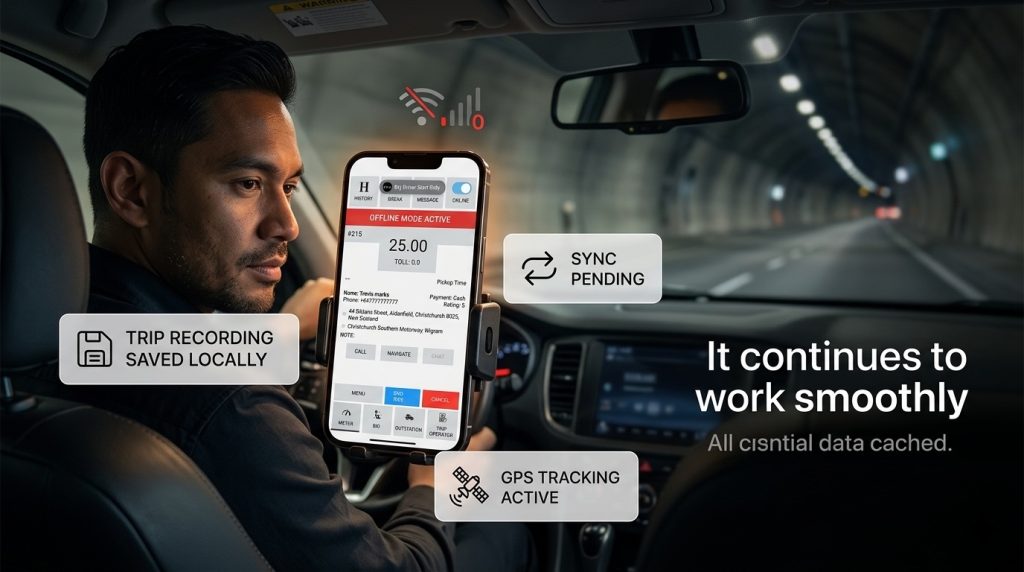
The Importance of Offline Capability in Taxi Driver Apps
In the modern taxi and ride-hailing industry, digital connectivity is often assumed to be constant and reliable. However, in real-world operations, network coverage can be inconsistent, especially in rural areas, underground parking zones, tunnels, or even during high network congestion in busy cities. This is where offline capability in taxi driver apps becomes a critical feature rather than just an optional enhancement.
Offline functionality ensures that drivers can continue accepting trips, recording distances, and updating ride statuses even when there is no active internet connection. Once connectivity is restored, all data automatically synchronizes with the backend system. This seamless operation helps maintain service continuity and prevents revenue loss caused by network disruptions.
In traditional taxi systems, lack of connectivity could mean missed bookings, incomplete trip records, or even disputes between drivers and operators. Modern dispatch systems eliminate these problems by storing trip data locally on the driver’s device until it can be synced. This ensures that no booking or earnings information is lost, even in challenging environments.
Another major advantage of offline capability is improved driver reliability. Drivers often operate in areas where mobile data coverage fluctuates. Without offline support, they would need to constantly worry about losing connection, which can negatively impact their performance. With offline-enabled apps, drivers can focus entirely on driving and passenger service without technical interruptions.

From an operational perspective, offline capability also improves system resilience. Taxi businesses depend heavily on continuous data flow between drivers, riders, and backend systems. If connectivity issues occur and the system does not support offline operations, it can result in incomplete data, incorrect fare calculations, and operational inefficiencies. Offline functionality acts as a safeguard, ensuring that business operations continue smoothly regardless of external network conditions.
GPS tracking plays a crucial role in offline driver apps. Even without internet access, the app can continue recording location data using the device’s GPS module. This allows accurate trip reconstruction once the system reconnects. Fare calculation based on distance and time can also be stored locally and later verified by the backend system, ensuring transparency and accuracy.
Another important aspect is user trust. Passengers expect accurate billing and reliable service. If a trip is disrupted due to connectivity issues, it can lead to confusion or disputes regarding fare accuracy. Offline capability eliminates this risk by ensuring that every movement and time interval is recorded properly and synced later without data loss.
For taxi operators, offline functionality also provides a competitive advantage. Many legacy systems still rely heavily on continuous connectivity, which limits their usability in certain regions. By adopting modern dispatch software with offline support, businesses can expand their service areas without worrying about network limitations.
Additionally, offline capability improves scalability. As taxi companies grow and expand into new cities or regions, they often encounter varying levels of network infrastructure. A system that works seamlessly both online and offline ensures that expansion does not require additional technical adjustments or infrastructure investments.
In conclusion, offline capability in taxi driver apps is not just a technical feature—it is a fundamental requirement for building a reliable, scalable, and efficient taxi business in 2026. It ensures uninterrupted operations, improves driver performance, enhances passenger trust, and strengthens overall system resilience.